As announced in an earlier blog-post, i implemented a RemoteRunner for the jtalk-server (based on the jtalk-project). It's very simple: if you implement a Method runRemote in your class, e.g. RemoteTest, then by executing:
RemoteRunner new runClass: RemoteTest
will execute the Smalltalk-Code implemented in the runRemote-Method on the server. The example prints out the date and time of the server.
To see how the results can be transferred back to the client-caller, just look at the example-class.
The jtalk.js on the server-side is exactly the same as the one on the client-side. So if you make changes, don't forget to press the button "Export & Save JTalk to DB".
If you like to play around with this new feature and you played around with jtalk-server before (and pressed the save-button), you need to reset the jtalk.js by pressing the button. This is because, the jtalk.js will be saved to the database for every user (identified by his/ her google-id). So changes made to the jtalk.js, which is located in the server-filesystem won't get executed, because on startup (page-load) a jtalk.js in the DB, associated with the current google-user, has priority.
The JVM of the JDK/ JRE 6 is packaged with a ScriptEngine for executing Javascript. This feature is currently not supported on the Google App Engine, so i needed to use the "external" Rhino-jar, and a slightly different mechanism. Here is some work needed on optimizing the server-execution. So, the jtalk.js on the server should get reduced to the classes that are needed on the server (no canvas etc.) and most imported, the precompiled jtalk.js should get persisted somehow. Currently the complete javascript-source of the Smalltalk-System is executed/ interpreted for every call on the server.
But the next step will be to use the GAE persistence-layer via java-calls from Smalltalk/ Javascript to the google-api. Calling java is already possible and i think this is where the fun begins ...
Mittwoch, 25. Mai 2011
Dienstag, 10. Mai 2011
Smalltalk & Java: JTalk Server
Recently I was playing around with the amazing Jtalk Project. It's a Smalltalk-System running on top of Javascript - completly in your browser!
I have some far away goals for software development in mind:
1. develop Software from within a Browser
2. use Smalltalk as primary Language, because it's the best programming language ever :-)
3. have interfaces to the JVM, so i can use sophisticated and reliable frameworks
There are a few Projects i know of, that address the goal of integrating Smalltalk with the Java (redline, Athena) but none of them seems to be very stable.
Now i found out, that Jtalk could do the job! So i spend a little time to set up a project hosted on the google app engine that serves as a development home for Jtalk Projects, where you have the possibility to save the current "state" (the complete source) to a database and resume developing anywhere anytime. You need a google-account to use it.
In this thread on the jtalk-discussion-group, i showed that it is possible to run Jtalk on top of the JVM and execute Smalltalk-Code. The way back - calling Java-Classes from Smalltalk is shown also.
At the moment my project only uses Jtalk on the client-side, the next step will be, make it run on the server-side.
Here's the link to where you can test JTalk Server: http://jtalk-server.appspot.com/ and the code is here: http://code.google.com/p/jtalk-server/
Any help, tipps or comments are welcome!
Dienstag, 27. April 2010
Ich war dabei!
Ich war am 24.4.2010 Teil der 120km langen Menschenkette zwischen den Atomkraftwerken Krümmel und Brunsbüttel und habe gegen die Pläne der Bundesregierung demonstriert, die Laufzeit der Atomkraftwerke zu verlängern.
Tolles Wetter und trotz ernstem Anlaß ein riesen Spaß. Ein großer Tag für die Anti-AKW-Bewegung.

Tolles Wetter und trotz ernstem Anlaß ein riesen Spaß. Ein großer Tag für die Anti-AKW-Bewegung.


Donnerstag, 22. April 2010
Google apps script und 43things
Eher zufällig bin ich auf ein ziemlich praktisches Feature bei Google Docs & Spreadsheets gestoßen: Es gibt einen recht ausgereiften Javascript-Editor (Syntax-Highlightning, Code-Completition) mit einer umfangreichen API zur Manipulation von (u.a.) Tabellen-Dokumenten.
Auf einfache Weise lassen sich andere Google-Services aber auch beliebige Web-Services einbinden. Selbst das Menü der Spreadsheet-Ansicht kann man erweitern.
Um das mal auszuprobieren, habe ich das "Zielerreichungs-Portal" 43things eingebunden. Den Code gibt es hier und bald auch in der Google-Script-Gallery.
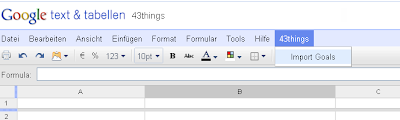 Den Script-Editor erreicht man unter dem Menüpunkt "Tools" - wenn die Funktion onOpen() ausgeführt wird, erscheint der zusätzliche Menüpunkt "43things". Wenn das Script mit der Tabelle gespeichert wird, wird onOpen() automatisch beim Laden des Dokuments aufgerufen.
Wählt man "Import Goals" aus, wird man aufgefordert, den 43things-Nutzernamen einzugeben und schon werden die Ziele und Einträge zu den Zielen des Nutzers in die Tabelle eingefügt.
Allerdings ist die Anzahl der Einträge pro Ziel momentan auf 20 beschränkt - das hängt mit der Pagination-Einstellung des aufgerufenen Services zusammen.

Montag, 19. April 2010
WLAN und LAN sichern mit IEEE 802.1X und RADIUS
 heise.de hat heute meinen C't Artikel aus dem Jahr 2004 ("Schlüsseldienst") generalüberholt und aktualisiert (von mir) auf heise Netze veröffentlicht.
Unter dem Titel "WLAN und LAN sichern mit IEEE 802.1X und RADIUS" gibt's eine Übersicht über IEEE 802.1X, RADIUS und EAP.
Sonntag, 18. April 2010
Squeak on Android
 Seit geraumer Zeit arbeite ich am "Squeak on Android" Projekt mit: http://code.google.com/p/squeak-android-vm/ - ich möchte hier nur kurz auf den hohen Coolness-Faktor hinweisen.
Wenn das alles richtige funktioniert, kann man mit Squeak/ Smalltalk (die beste Programmiersprache der Welt) auf einfache Weise Anwendungen für das Android-Betriebssystem entwickeln.
Ich glaube, dass das Android OS seinen Marktanteil als Betriebssystemen für Mobiltelefone in Zukunft erheblich steigern wird und dass es sicherlich demnächst sowas ähnliches wie das iPad von Apple auch von Google geben wird. Es lohnt sich sicher, sich mit dieser Plattform näher auseinanderzusetzen.
Außerdem ist mir Android viel sympatischer als die meisten anderen Plattformen für die Entwicklung mobiler Anwendungen, incl. iPhone etc. - Android ist ein offenes System, es gibt komfortable/ freie Entwicklungsumgebungen für die Entwicklung von nativen Anwendungen und für die Entwicklung mit einer Java-API, außerdem gute Dokumentationen und Diskussionsforen.
Aber der Hauptgrund, warum ich das mache: Weil ich Spaß daran habe.
Dienstag, 23. Juni 2009
BabyTwitter

Eine recht nerdische Form des Babyphones: Wenn das Geschrei des Nachkommens einen gewissen Lautstärke-Level übersteigt, wird eine konfigurierbare Nachricht über den ebenfalls konfigurierbaren Twitteraccount gesendet.
Ich habe dafür z.B. einen extra Twitter-Account angelegt: stefcom_alerts, dem ich mit meinem normalen Twitter-Account stefcom folge. Wenn mein Sohn in seinem Bettchen jammert, sehe ich das sofort in meiner Twitter-Timeline auf dem Handy.
Keine große Sache, das kleine Java-Programm war mehr nur so eine Programmierübung in einer schlaflosen Nacht während meiner Elternzeit. Vor allem die Lautstärke-Erkennung ist wahrscheinlich noch nicht perfekt und müsste mal überarbeitet werden.
Hier die Sourceforge-Seite des Projekts: http://sourceforge.net/projects/babytwitter/
Abonnieren
Posts (Atom)
 Ich war auf dem